


A student’s ambition is not always visible on a transcript.
At the beginning of the school year, clubs, sports, and leadership opportunities quickly fill calendars. For some students, joining them is an expected part of high school, while for others, participating in several extracurricular activities is simply not possible.
At South, 64 percent of students said they were unable to join a club or extracurricular activity because of other commitments, according to an unscientific survey conducted by The Oracle.
Some students may work after school. Others care for younger siblings or family members, work at a job/family business, manage responsibilities at home, or have other obligations that don’t come with a title or award that fits on a college application or resume.
Yet when a student is not involved in many activities, it can be easy to assume they are not ambitious, don’t care about school, or aren’t taking advantage of available opportunities.
But opportunity is not the same as access.
About two-thirds of K-12 parents with children who play sports estimate spending up to $2,000 each year on equipment, fees, training, and travel, according to an August 2026 poll done by Associated Press and Public Institute of Opinion Polling Sector (Ipsos). Participation also varies by household income: about 7 in 10 parents who make at least $100,000 annually said their children play organized sports, compared with about 4 in 10 in lower household incomes children.
These numbers do not mean every lower-income household lacks access or that every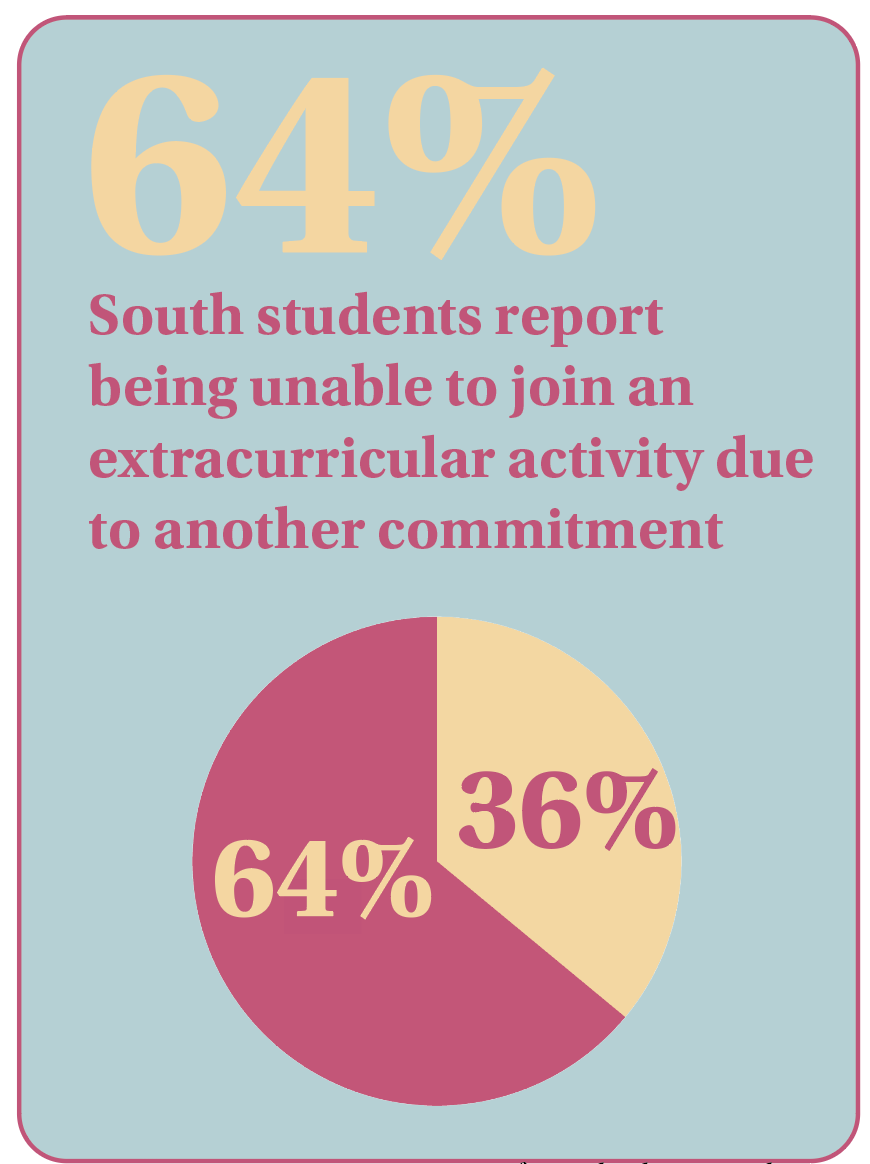 participating student comes from a wealthy family. But it does demonstrate that participation is influenced by circumstances beyond a student’s motivation.
Time can be just as significant as money. About 8 in 10 parents of children involved in organized sports consider scheduling, logistics, or time commitments a challenge, according to the Associated Press and Ipsos poll. For students balancing school with other responsibilities, another two-hour commitment after school may not be realistic.
This is where our understanding of success can become too narrow.
Students who hold leadership positions, compete in multiple sports, or participate in several clubs are often the easiest students to recognize. Their accomplishments are highlighted in announcements, yearbooks, articles, and college applications, creating a clear picture of what a “successful” student looks like.
But visibility is not the same as ambition.
Clubs, sports, and leadership opportunities are still a meaningful part of high school, but we should question why participation has become a measure of how motivated a student is.
When we talk about student success, we should consider the work that happens outside of academics. A student working several hours after class is developing a work ethic. A student caring for family members is taking on responsibilities that may never appear on a transcript. And a student who cannot afford an activity may have the same drive as someone who participates in five.
Schools and students shouldn’t lower their standards, but they should broaden them. If we want to understand our school community better, we have to recognize that some of the most ambitious students may be doing their most important work where we cannot see it.