
We often talk about taking people for granted, but we rarely think about the places we take for granted, too.
Familiar places become part of our routines. We return to them without thinking about what they mean to us because we assume they will always be there, offering the same comfort and security they always have. Sometimes, it takes an unexpected event to make us realize how much we depend on that familiarity.
Recently, news broke about a threat targeting the Sri Venkateswara Swami (Balaji) Temple in Aurora, a temple I have visited many times.
Learning about the threat was frightening, but what made it especially difficult to process was how close it felt. Knowing that a place so familiar to me could have been the target of something so frightening made the news feel different from the stories I see online.
It’s easy to read about events happening somewhere else and feel sympathy for the people affected. But when something happens close to home, the impact on your own life is different. Suddenly, it is not just about what happened to other people—it is about a place you know, a community you are part of, and people you care about.
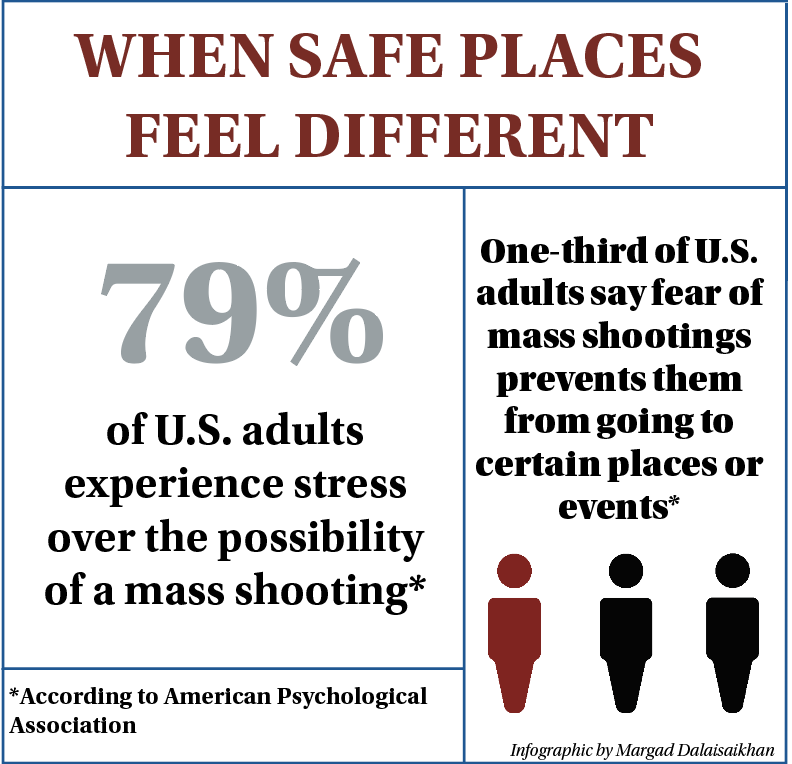
This feeling is not uncommon. About one-third of adults say fear of mass shootings prevents them from going to certain places or events, according to a 2019 survey conducted by the American Psychological Association (APA) and The Harris Poll. The survey also found that 79 percent of adults experience stress over the possibility of a mass shooting, showing that the fear surrounding such events can extend beyond those directly involved, affecting how people think about their everyday surroundings.
These experiences can also change more than our perception of the event itself. It can change how we feel about returning, how aware we become of our surroundings, and whether we can experience the same sense of comfort we once did.
A place can look exactly the same yet feel completely different.
We often associate safety with the people around us, but our environment can be just as important. A place might represent family, community, tradition, or years of memories. For some, it might be a place of worship. For others, it could be a school, a neighborhood, or a local business they have visited for years.
These places become meaningful not only because of what happens there, but because of the sense of belonging they provide.
When that sense of safety is disrupted, it is not always easy to return to the way things were. Someone might feel uneasy revisiting a place where they once felt comfortable. They might become more cautious or find that an experience stays with them longer than they expected.
Those reactions should not be dismissed.
Feeling unsettled after a frightening event does not mean someone is overreacting, and taking longer to feel comfortable again does not mean they are unable to move forward. People process uncertainty differently, and what seems like an ordinary place to one person may carry a very different meaning for someone else.
It is also easy to overlook these feelings when we have not experienced the same thing ourselves. People might assume that because a place still looks familiar, it should feel familiar, too. But physical surroundings do not tell the whole story. We cannot always see what someone associates with a place or understand why returning to it might be difficult.
Ultimately, we cannot always control what happens in the places that matter to us, but we can recognize their importance before something forces us to.
We can appreciate the comfort of familiar routines, the communities we return to, and the spaces that make us feel connected to something larger than ourselves. And when those places no longer feel the same, we can allow ourselves and others the time to adjust.