
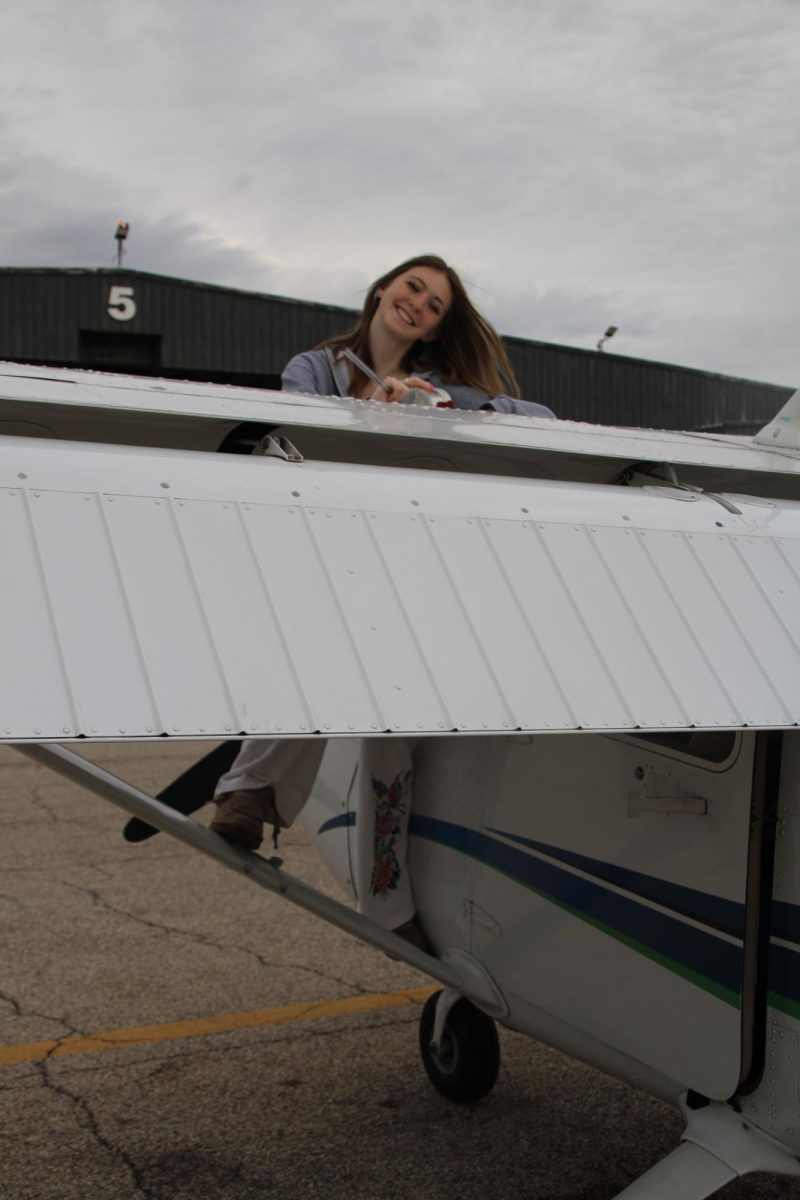
The moment the plane lifts off the runway, the sky becomes more than a place to fly for senior Sophie Collin. It becomes a connection to her grandfather, whose photograph of him in the cockpit of a B-29 Bomber first inspired her to imagine herself as a pilot. As Collin trains for her private pilot’s license, each takeoff brings her closer to her dream of attending the Air Force Academy and becoming a fighter pilot.
Through flight lessons and ground school, student pilots work towards earning their private pilot licenses while balancing the demands of high school. While some hope to pursue military aviation and others commercial aviation, they all share an interest in turning their passion for flying into a future career. For Collin, that means squeezing in flight hours around school work, she said.
With 35 flight hours out of 60 required, Collin focuses on both scenery and monitoring the plane, constantly checking her altitude and airspeed while keeping her hands on the controls during flight, she said. As she works toward flying solo, she practices maneuvers such as stalls, spins, and emergency procedures, Collin said.
“I’m constantly thinking about what I’m doing and looking out the window,” Collin said
Whether she faces difficult weather or struggles with landings, she remains determined to pursue aviation, Collin said.
“There’s this lesson my grandpa taught me, it was the way he lived life,” Collin said. “He lived life to the fullest, not letting bad things dictate him. That’s a really important lesson for someone to live by. And whenever I fly, I truly feel that lesson.”
Collin’s experience is one of several paths South students are taking into aviation. While Collin hopes to fly military aircraft, senior Nick Kirklakis wants to pursue commercial aviation. Kirklakis’ interest in aviation began in middle school, when people around him, including his father, introduced him to different aspects of flying, Kirkakis said. After taking a discovery flight in September of last year, Kirklakis began working toward his private pilot’s license, he said.
Kirklakis trains at Flight Synergy Chicago two to three times a week, often starting lessons after school and flying until sunset. Attaining a license requires taking three exams: a written test, a speaking test, and a practical check ride, he explained.
“Sources that we use to study and prepare for flights include our flight instructor, a training platform of choice, the Federal Aviation Regulations/Aeronautical Information Manual (FAR/AIM), and the Pilots Handbook of Aeronautical Knowledge (PHAK) which contains basic knowledge student pilots should know,” Kirklakis said.
Junior Ryan Comer was first drawn to aviation through videos, he said. His interest grew when a family friend who flies private jets took him up in a small plane, encouraging him to pursue his own private pilot’s license, Comer explained.
Despite the challenges of flight training, students interested in aviation should pursue it if they have the opportunity, Comer said. While it can be demanding, the experience is rewarding, each flight giving opportunities to build confidence in his ability to handle intense situations, Comer added.
“Every day you’re getting to do incredible things, and it is demanding and stressful, but it’s also very rewarding,” Comer said. “Lots of people can definitely do it even if they think that they can’t.