
The glare of Adobe InDesign, the click of a mouse, the burst of camera shutters, and the faint crackle of a live audio feed fill studios across the school. From the newsroom to the pages of fashion and literary magazines, student publications offer paces for students to share their voices. Whether it is working on Etruscan, The Oracle, STITCHED, Calliope, a TV and Film project, or WGBK 88.5 radio station, creativity and collaboration are abuzz.
Etruscan: years’-worth of memories stuck in print
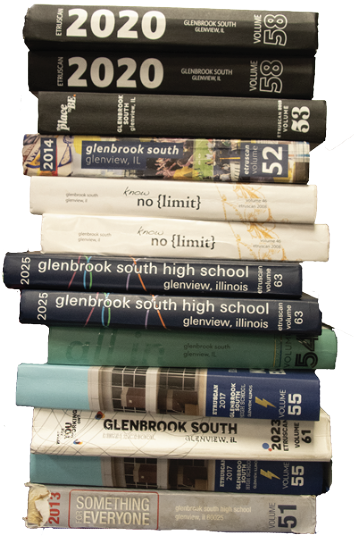
Etruscan, the yearbook, starts planning for the year ahead during the summer, senior Anna Chen, Co-Editor-in-Chief (EIC), said. The EICs first plan out a ladder, a spreadsheet with what information will be on each page of the 364-page yearbook, Chen said.
Etruscan has Design Editors, who work to find a design to incorporate throughout every page of the book. Student Life, Academics, Sources, Happiness, and Index Editors work on ensuring students from every corner of the school are involved in the book. Sports Editors not only cover all the sports, but also work to correctly identify athletes and keep track of the scores from every single game of the season. People Editors work on three types of pieces: Quick Reads, 50-75 word response prompted by a question related to the yearbook theme, Humans of New York, a 150-word quote about a unique aspect of a person’s life, and Larges, a 350-word section about a specific area of someone’s life that stands out, Chen explained.
A journalism class provides opportunities for leadership because the publications are student-run, Kristen Porter, English Teacher and Etruscan Adviser, said. Also, members enhance their teamwork and learn to work respectfully with others, Chen added.
“Everybody is intertwined with everybody else,” Chen said. “We’re working and bouncing ideas off each other and asking for sources. Working as a team makes the book cohesive and fluid.”
As adviser, Porter changed the process to join. Originally, the class was only accessible through teacher recommendation, but now the class is open to anyone who wants to join, Ported said.
“Yearbook is a safe space for students to be themselves and find friends,” Porter said. “It’s hopefully a memento that you take from high school and keep, so you can look back on it even 20 years from now.”
The Oracle
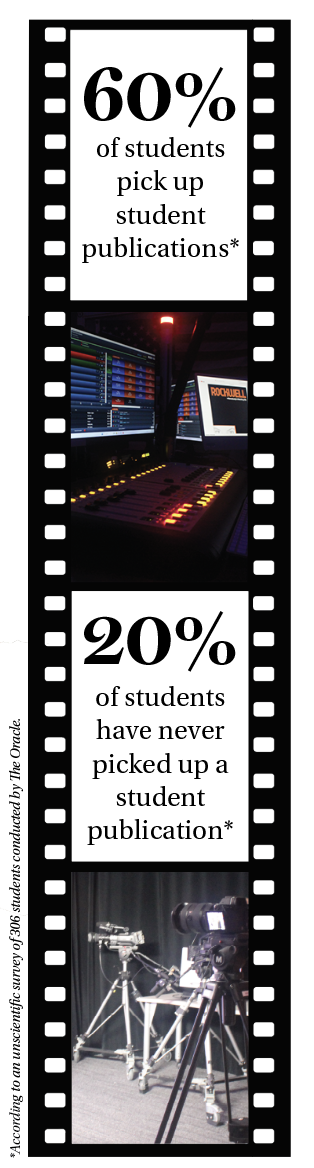
Publishing seven issues each year, The Oracle, the student-run newspaper, is open to editors, writers, illustrators, and photographers, Bob Wysocki, English Teacher and The Oracle Adviser, said. Members work to collect diverse voices to implement The First Amendment, free speech, Wysocki said.
Wysocki grew up reading the paper, and to him it was a way to learn about the world. Today, there are a variety of ways to get information, which is great, but with the addition of Artificial Intelligence, ethical guidelines for journalists are bent more often, Wysocki explained.
“It’s important to find places where people practice journalism,” Wysocki said. “You might not agree with everything you read or everybody’s opinion, but if you read it and think, ‘Well, I don’t necessarily agree with that,’ you’re engaged in figuring out what you want to believe in.”
Each issue starts by choosing and planning stories, before sending out assignments and having writers do two update responses that allow the story editor to know how things are going and help with issues, Wysocki added. Writers then submit first and final drafts, and after final drafts, the EICs and Wysocki go through the stories for red flag edits, looking for style errors, reviewing content, and checking for bias. The issue is wrapped up with layout, a week-long period where editors design pages.
After becoming an assistant editor her sophomore year, the possibility of eventually leading the paper began to take shape, senior Mae Kuchimanchi, Co-EIC, said. The decision to take on the role grew out of a connection to the publication that extended beyond editing and writing, Kuchimanchi added.
“I knew I wanted to stay with the community because I found people who care so much about the same thing that I do, and that is so rare to find, especially in high school,” Kuchimanchi said. “To me, that was really special.”
STITCHED: stretching boundaries with fashion
Now in its sixth year, STITCHED, a student-run fashion magazine, began with a group of Advanced Photography students who were passionate about fashion, Amie Elliott, Art Teacher and STITCHED and Calliope Adviser, said. The first edition was modest, but since then, the magazine has grown more creative, with increasingly adventurous layouts and photo shoots, Elliott said.
STITCHED offers opportunities to contribute beyond photography and modeling, Elliott said. From makeup to assisting with photo shoots, the magazine welcomes students with a variety of interests and skill sets, she explained. The process begins
concepts into designs, senior Mari Zoljargal, STITCHED President, said.
“As a club, we help members conceptualize their ideas so they can become a reality,” Zoljargal said. “You have full control over what you do, and it’s really fun.”
STITCHED is an opportunity for students to step out of their comfort zone and explore their personal style, Elliott explained.
“A lot of students want to look individual, but not too individual,” Elliott said. “I wish for STITCHED to open more doorways for people to express themselves visually, and for people to step a little out of the safe box of whatever the style is at the time.”
Calliope fosters creative arts, expresses passions
Calliope, the literary and art magazine, has been part of the school community since the 1980s, originally featuring writing exclusively before expanding to include other forms of art, Elliott said. Beginning production by choosing a semester theme that guides submissions, members brainstorm ideas and weigh out pros and cons before settling on a theme, Elliott said.
Once the theme is selected, members create posters and make announcements encouraging students to submit their work, sophomore Anujin Castillo, Junior EIC, said. Editors then evaluate each submission based on how well it fits the theme and contributes to Calliope, Castillo said.
“We review each piece as we look at questions like how much it connects to the theme, how original it is, how engaged we are, which in turn affects what submission we put in,” Castillo said.
Elliott finds that although digital media allows students to share their work with broader audiences, printed magazines give their creations a more lasting, tangible feeling.
“Digital media is amazing, and you can do powerful things,” Elliott said. “But there is something about having a book in your hand. They are two different artifacts. Things on the internet are there forever, so, in that way, it has the same permanence as a physical book, but it has intangible value. A physical thing has so much more tangible value than something online.”
TV and Film framing South through unique lens
The TV and Film program has been a prevalent part of South for over 40 years, with projects like the Fall and Spring Sports, Spirit Videos, and the Variety Show video, senior Brendan Long, Station Manager, said.
Each project starts with pre-production, where students see who needs to be involved, sign out the studio, decide filming times, and write scripts if necessary, Long explained. Next is filming the project, then post-production, where members edit their videos, Julie Benca, Broadcasting Teacher and TV and Film Director, added. The final step is showing the project to the class and critiquing to see what can be improved upon for future projects, Benca said.
When Benca was a student at South, many of the projects were studio-based, something shot on a set, or live shows, she said. Now, there are some live projects, but many of them have evolved with trends, for example, single-camera format projects, like documentaries, have gained popularity in recent years, so that has been incorporated into the class, Benca added.
“TV and Film holds a special place in my heart since this program did a lot for me while I was a student here,” Benca said. “I’ve met a lot of great students here and now some of them are adults working in the industry and have been working in the industry for almost a decade.”
Working on these projects, students learn practical skills such as video production, time management, communication and problem solving, Benca said. In addition to practical skills, students improve film making, leadership, and creativity, Long said.
“TV gave me an outlet to express myself creatively and I’m proud that I’m getting better at film making,” Long said.
WGBK 88.5 broadcasting Titan culture, pride
Sitting in front of the radio control board, senior Lily Fontana, Station Manager, hosts her Wednesday night radio show. WGBK 88.5, the Glenbrook Radio Station, is shared by South and North, and South has it Mondays, Wednesdays, and Saturdays for hour-long shows covering an array of events from football games to music album reviews, Fontana said.
For a show, people come in 15 minutes early to set up and go over scripts before going live at the hour mark, Fontana explained. There is a schedule of productions, such as PSAs or short news segments, that get played throughout the show at specific times, Fontana added.
Radio students follow the expectations of a professional broadcasting station and are responsible for everything from management to programming to interviews with students or professionals, Broadcasting Teacher Daniel Oswald said. Because of the radio class, Fontana is looking to pursue a career in broadcasting to become a news reporter.
“The skills that I’m learning in radio and the way that I am able to express myself has really helped me find myself, and it’s opened my eyes to a future after high school,” Fontana said.
Radio’s accessibility serves people at a low cost, which is very valuable to people who live in a community without cell phones, internet connectivity, computers, or television screens, Oswald said. Radio bridges a gap to make sure people stay connected, educated, and informed, he added.
“I’ve always loved the fact that radio could reach a large number of people using technology that is decades old and can provide information and education,” Oswald said. “Radio should feel like a conversation between two people, even when the person on the microphone is speaking to 100, or 1,000, or 10,000.”