


Every so often, teachers trade the front of the classroom for seats as students. At the National Council for the Social Studies (NCSS) Annual Conference, six South teachers joined nearly 3,500 kindergarten to high school teachers to gain new strategies, meet experts and colleagues, and spark renewed inspiration in teaching, David Berkson, Social Studies Teacher, said.
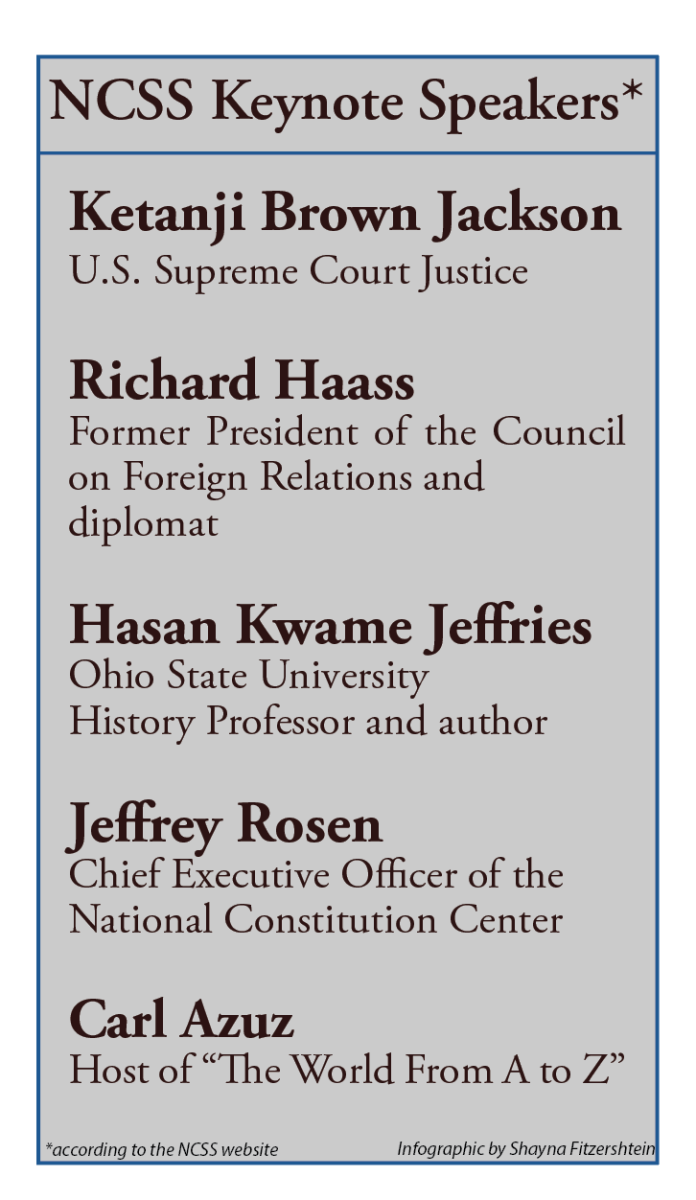
The conference, held from Dec. 5 to 7 in Washington D.C., featured various workshops, sessions, and speakers, Berkson said. It offered Berkson and Social Studies Teacher Emily Hinz, AP Psychology Teacher Sejal Schullo, and World History Teachers Daniel Ham, Artur Da Silva, and Max Armas a chance to build content knowledge, discover new ideas, and explore interactive spaces filled with books, materials, and tactile activities related to their subjects, Berkson said. A few of the keynote speakers included Associate Supreme Court Justice Kentaji Brown Jackson, House Minority Leader Hakeem Jeffries (D-N.Y.), and former “CNN 10” host Carl Azuz, according to the NCSS website. The NCSS includes all social studies classes, ranging from civics, history, psychology, and more, Berkson said.
“It’s not just about history,” Berkson said. “There’s these other social sciences in the conference too. It is multifaceted and super complex. What’s cool about this conference is that there is something for everyone.”
The conference gave teachers resources and ideas to implement in their classrooms, making class more engaging, Schullo said. Such resources could offer students the extra story or piece of information that expands their understanding in a way a textbook alone could not, Schullo added.
“I have learned some of the best ways to make classes more engaging, more in depth, and more interesting for students,” Schullo said. “I’m excited to dive in a little deeper and make my classroom a better experience for kids.”
Beyond classroom tools, the conference also offered a renewed sense of purpose, Schullo said. Being around other educators created a motivating and affirming environment to further her learning, she added.
“I always come out of NCSS feeling super re-energized as a teacher because you’re surrounded by people who love the things that you love, are passionate about similar topics, and are willing to share their expertise,” Schullo said. “One thing about teachers is that most of us love being students. We are lifelong learners and to be good and successful at our jobs, there needs to be continuous learning.”
Within the NCSS, there are special interest communities, one of which is the Psychology Community, Schullo said. She previously served as its co-chair before stepping down last year. As a result of her experience, Schullo saw how psychology educators have built a particularly strong network within NCSS. Over the years, the Psychology Community has expanded from having only one to two sessions to a full slate of them throughout the conference, Schullo said.
“Psychology used to be the ugly stepchild of social studies,” Schullo said. “It is harder to find your space in a subject area that’s predominantly dictated by history, geography, and civics. The psychology teachers had to rely on each other. We created a really great community where we share, ask a lot of questions, and are super supportive and tight-knit.”
In addition to supporting teachers, NCSS plays a role in education policy, Schullo said, advocating at both state and federal levels to ensure social studies remains a core part of public education.
“The NCSS makes sure that each state’s board of education remembers that social studies is important,” Schullo said. “The state councils, as well as the National Council, do a lot of work to help states establish standards for social studies and mandate certain topics.”
Connecting with each other and building camarad- erie happened naturally among the South teachers who attended together, Berkson said. He was especially excited to help guide colleagues who were experiencing the conference for the first time. With hundreds of sessions happening simultaneously, teachers often split up and compare takeaways afterwards, an experience that becomes its own form of bonding as they trade insights and discover new ideas together, Berkson said.
“Good professional relationships allow you to connect in ways that are outside of the classroom or office” Berkson said. “That’s the beauty of a big conference, it brings you closer.”