


Two of the 10 most expensive universities in the U.S. are within driving distance of South, U.S. News and World Report reported. The University of Chicago charges students $98,301 for attendance, according to the university’s website, and Northwestern Universite students pay $96,236 to attend, according to the university’s website.
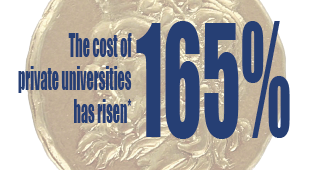
These $100,000 price tags are a new phenomenon, with the tuition at private universities rising 165 percent in the 21st Century and public universities rising to 40 times more than what it originally cost in 1963, the Education Data Initiative, a resource that studies the cost of education, reported in Febuary.
Three of four U.S. adults believe American teenagers are choosing not to attend college because they cannot afford it, the National Opinion Research Center (NORC) at the University of Chicago reported.
However, there are different ways students and their families can finance their education, Paul Syzdek, Career and Technology Education (CTE) teacher, said. One way includes receiving grants and scholarships, which do not have to be paid back. These are often provided by affinity groups, groups of people affiliated by their identity or cultural identity, clubs, or companies on an application basis, but it can often be difficult for students to navigate the application process, Syzdek said.
Loans are another option students can pursue. With the application process, students can take out private loans, issued by a non-government lender, or use money received from the Free Application for Student Aid (FAFSA), a government loan that accrues interest over time, Syzdek said.
“As an 18-year-old, it’s kind of hard to make these large financial decisions,” Syzdek said. “Some people walk out of college not knowing how much debt they have until they have to start paying it back.”
For families and students paying out of pocket, meaning they do not rely on loans or other forms of assistance, paying may impact other financial areas such as retirement savings or emergency funds, according to Gatsby Investment and Financial Planning, a monetary planning firm.
Another alternative to paying the high price for a four-year university is community college, a two-year public institution offering affordable associate degrees, technical diplomas, and certificate programs, specialized programs that serve as an alternative to a traditional degree. While Syzdek was accepted into many traditional four-year universities, his parents had five children and were not able to help him pay for college, so he felt it was a more financially responsible decision to attend a community college, Syzdek said.
“I saved myself $50,000 and still ended up in a career I wanted,” Syzdek said.
Syzdek now makes it a priority to teach his personal finance classes about the positives and negatives of the different options available to pay for college, Syzdek added.
“Chase your dreams, but in a financially responsible manner,” Syzdek said.
Another factor impacting students is the perceived prestige of the school, College Counselor Kalene Heaton said. Students make decisions based on selectivity, believing that is an indication of the quality of education, Heaton said.
“There are far more telling and worthwhile metrics that students and families should prioritize in their search.” Heaton said, “Consider job placement, retention rate, graduation rate.” and other metrics directly related to student experience and outcomes.”