
Math teachers and science teachers have been implementing Thinking Classrooms, an education philosophy that deepens students’ understanding of academic concepts by having them work in collaborative groups, Math Teacher Veronika O’Donnell said.
The philosophy was pioneered by Peter Liljedahl, Mathematics Professor at Simon Fraser University in Vancouver, Canada and author, who did a seminar four years ago with South and North teachers about the approach and its benefits, O’Donnell said. O’Donnell and other math teachers have been using some of the philosophy’s 14-part practices, O’Donnell said.
“In a thinking clasroom, you will see the teacher is not as much of a focal feature,” O’Donnell said. “Instead, the kids are leading the lesson on what they’re doing.”
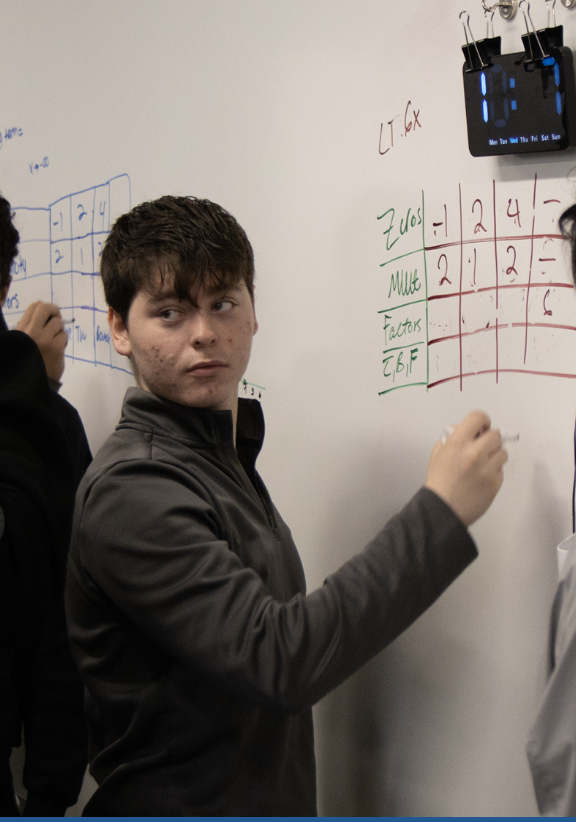
Randomized seating charts allow for students to work in new groups every day, O’Donnell said. The groups go to the whiteboards and the students have to work together to solve problems of increasing difficulty, she said. This group work allows the students to ask questions and think through the problems without requiring a lot of teacher intervention, O’Donnell said.
Senior Emily Szabla is currently in a precalculus class that utilizes the Thinking Classroom philosophy. The structure of the class has helped her learn to appreciate groupwork and the collaboration it builds, Szabla said. Being able to move around the classroom helps her stay focused as opposed to a lecture-heavy class.
“I learn better in a group environment because sometimes when I find myself doing individual work, I’ll be scared to go to the teacher and ask for help or ask other people around me because no one’s really talking to each other,” Szabla said.
The importance of the Thinking Classrooms does not only lie in the movement of students, but also in its insistence on teaching students how to think, Math Teacher Stephen Farber said. Students engagement is raised, so that they aren’t just memorizing formulas, but learning how to approach new problems in the future, Farber said. Every student has the opportunity to learn from the philosophy, regardless of capability and math level, Farber said. After using the practices in his classroom, he noticed a shift from simply memorizing concepts to actually finding the logic and reasoning that is in math, he said.
“Teachers want students to understand what they are doing, and the only way to understand is to practice and reflect on what you’re doing,” Farber said.