

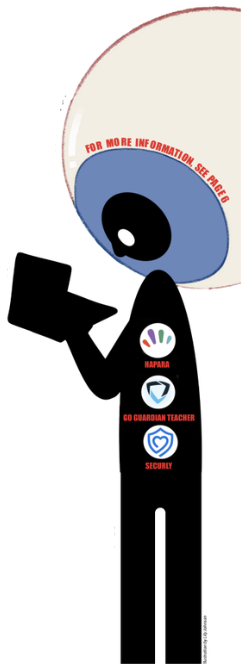
 District 225 is testing three different classroom management platforms that will allow teachers to view students’ browsers from their laptops, open and close tabs on the students’ computers, and send direct messages to students that will appear directly on their screens, Principal Dr. Barbara Georges said. The purpose of the program is to help students stay focused and minimize distractions, Georges said.
The three software programs, GoGuardian Teacher, Securly Classroom, and Hāpara, began their testing phase on Jan. 19 and will conclude on May 8, with each platform being tested by participating teachers for a respective four consecutive weeks, according to a District 225 Memorandom. The program is only able to be used from 7 a.m. to 3:15 p.m., when students are on school WiFi and signed into their school Google account for any monitoring to occur, a D225 Memorandom said.
“There is no tool or resource that the Glenbrooks would leave unturned to give students the greatest possible education,” Georges said.
While 73 percent of students feel this is an invasion of their privacy, according to an unscientific survey of 312 students conducted by The Oracle, the district feels there is no privacy issue because anything on the school’s network, on district devices, during the school day is open to revieaccording to board policy.
“If it’s only classwork on your computer, how is that an invasion of privacy,” Georges said.
After the district introduced a new rule in Aug. 2025 requiring all students to use their district-issued Chromebooks, they noticed students would find other ways to distract themselves, Georges said. This made classroom management software the next logical step, Superintendent R.J. Gravel said.
“It’s hard if you’re a teacher and trying to keep students’ attention, you need to walk around to see if they are on task,” Gravel said. “These tools are intended to keep students focused on the task at hand.”
Students believe that it is unfair and excessive for the district to monitor them since students and their families pay for their Chromebooks, senior Ellen Llacsa said.
“Even though it is supposed to only run during school hours and during class, you still run the risk of impeding on students’ privacy,” Llacsa said. “We put a lot of money into our Chromebooks and personal devices, and so it is reasonable to have an expectation of privacy.
Additionally, keeping students on task is the responsibility of the teacher, and if it is on such a broad scale, that speaks more to the quality of the teacher than it does the students, Llacsa said.
However, teachers act in the role of a parental guardian during the school day and have the right to make sure you are on task, junior Alexis Northrip said. The role of a school is to support its students and ensure that students are passing their classes and learning, as well as learning important life skills, Northrip said. Monitoring software helps to ensure students are putting in the amount of effort that will be reflected in their grade, Northrip said.
“High school is not supposed to be a sink or swim environment,” Northrip said. “We have so many student support programs because we want people to do their work, learn, and succeed. College is the sink or swim environment, but it is high school’s role to guide you and help you build those habits.”
From the perspective of the teacher, these monitoring programs can be very helpful in many ways, English Teacher Hilllary Kane said
“I am absolutely for it,” Kane said. “What I did not expect is that I can see when students are struggling. If someone has not started their essay when other students are on the first body paragraph, I am able to go over and help.”
Only 35 percent of students believe that this software will be effective in helping teachers better manage their classrooms, according to The Oracle survey.
Since there are several workarounds to bypass these programs, like disconnecting from the school WiFi, the programs may be ineffective, sophomore Olivia Petrungaro said.
“People always find loopholes,” Petrungaro said. “It’s like the saying that strict parents breed sneaky children. The software is not necessarily a bad choice, just maybe an ineffective one.”
If students have issues, they should reach out to the administration, Gravel said.
“If there is something we are missing, we encourage students to reach out to their teacher or us directly,” Gravel said.