As morning rays peak through the glass, students buzz through The Link, weaving through clumps of friends and several doorways to reach their next class. During school, bathrooms always have a line during passing periods, and empty cafeteria tables are a rare commodity; students are forced to spill into the hallways to eat with their friends. When the final bell rings, students speed-walk to the filled parking lot, where traffic piles up for ten minutes after the bell.
However, over the next decade, the hallways will become less packed, the bathroom wait times will shrink, finding seats in the library will be easier, a cafeteria table will no longer require searching, and there may even be spare parking spots in the West Lot, Principal Dr. Barbara Georges said.
“The declining enrollment will bring South back into a more normal size, a size that aligns with what this building was intended to serve, and a size that allows for more opportunities for students,” Georges said.
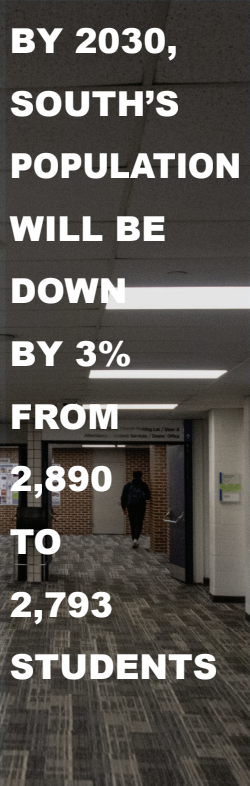
When the senior class of 2025-26 graduates, so does an overpopulated South, due to what Georges described as the “normal cycles” in Glenview’s population demographics. With this information in mind, South’s future classes will be around 550 students, while class of 2026 and before were around 700 students. Enrollment at South is projected to decline over the next decade from 2,890 to 2,793 students, according to Dr. Kim Ptak, Director of Operations and Chief School Business Official, and Lauren Bonner, Associate Principal of Operations and Student Experiences, in the Enrollment Forecast Update, an analysis of District 225 population, for 2025-26. The enrollment predictions in the report are done by both an external demographer and district staff.
“The population we are moving towards is what South was at for a very long time,” Georges said. “It is not like South’s new population is going into some new unknown territory; we are returning to what South’s population was in the past.”
The forecast was produced by analyzing housing and employment data, mortality and fertility rates, and other population-related sources, according to the update. When a forecast was made in 2024, it overestimated the enrollment for the 2025-26 school year by 63 students. Additionally, it predicted higher enrollment for the next 10 years than the most recent forecast now estimates, since fewer older homeowners are selling, according to the report.
Instead of the 2024 forecast’s predicted enrollment of 2,847 students for the 2024-25 school year, the Enrollment Forecast Update for 2025-26 estimates 2,745 students for that year. As of October 2025, South has 2,857 students. This number will drop by 64 students, 2.2 percent, in the next decade, according to the report.
In Glenview, the population has increased 16 percent over the last two decades, and it is now expected to level off around 50,000 people, David Just, Director of Communications for the Village of Glenview, said. Similarly, the Glenview youth population has also remained stable over the same time span, and that population makes up around 25% of Glenview, Just said.
South plans to keep the same course offerings but may offer fewer sections of a class to adjust to the new population size, Georges said. For classes with only one section that will struggle to meet the 17-student minimum to run, courses will be stacked into the same class period, Georges said.
“We will do everything in our power to make sure that any idea or opportunity gets explored and supported, and we are still going to be large enough to be able to do that,” Georges said. “I want people to be prepared that some things might look different.”
With fewer students in the building, activities such as sports and theatrical productions may look different in upcoming years, becoming less competitive and more inclusive, Georges said.
Currently, our school is home to over 120 clubs and organizations, according to South’s website. However, this number could lower as niche clubs that struggle with attendance may be affected by a decrease in potential members, Mark Maranto, Assistant Principal of Student Activities, said.
“I think it is safe to say fewer students means possibly, I hate to say, fewer clubs,” Maranto said.
Through a tracker that compiles information from QR codes students scan at clubs, Maranto can monitor club attendance and trends. A club must be reaching the minimum average of 10 students, Maranto said.
To foster involvement in activities, the Student Activities Office (SAO) rescheduled the student activities fair to the beginning of the school year, from January, to more effectively recruit students, Maranto explained. A significant factor in keeping clubs running is students ensuring the sustainability of their clubs after they graduate by structuring the transition of leadership, Maranto added.
“My work with clubs lately has been, ‘You got to think about the future beyond your time at South,’” Maranto said. “Otherwise, the club does not exist beyond you.”
While the decline may affect enrollment in athletics, South’s athletic department will continue to focus on supporting teams with smaller numbers and building up participation, Tom Mietus, Assistant Principal of Athletics, said. While there is no plan to create major changes in the structure of teams, the department will prioritize smaller-number teams.
“One of the goals that both South and North athletic departments are going to have moving forward into next year is trying to increase participation numbers,” Mietus said.
As South is changing, crowded shoulder-to-shoulder assemblies might evolve into a singular student body assembly. Students will have a different experience in the hallways, cafeteria, parking lot, and the large building will begin to feel even larger, so it is important to be flexible, Georges said.
“We have to be ready for some of the population changes to be different and new,” Georges said. “I believe the changes are going to be moving us in a more positive direction.”