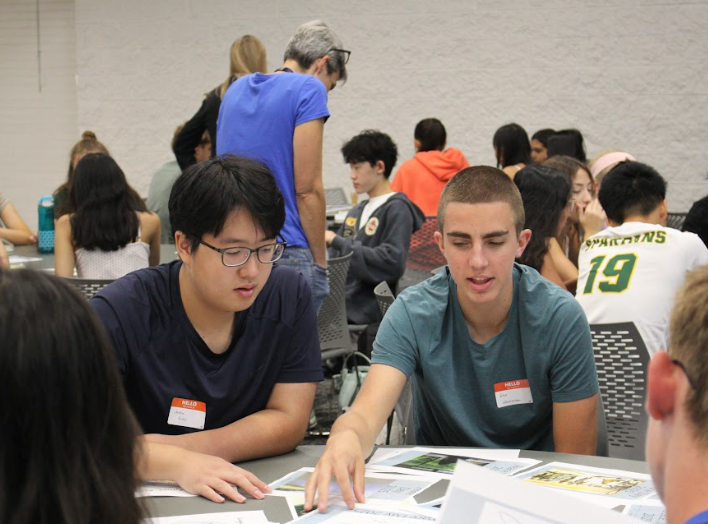


Students in the Glenbrook Academy of International Studies bustle about the Lyceum, immersing themselves in discussions of human rights while working to make a tangible impact through a new initiative: Peace Day. Introduced this year, the multi-day event is set to become a tradition for the Academy program, giving students the opportunity to create change on a larger scale, Deborah Cohen, Instructional Supervisor for the Glenbrook Academy for International Studies, said.
The notion of Peace Day sprouted as a way to introduce an experience unlike anything the Academy has done before, Cohen said. Unlike the program’s past structure where grade levels interacted minimally, the initiative brings together all four grades of Academy to collaborate. This year, it has taken the form of four separate days each centered on a different aspect of peace, with events being held at both North and South. As the idea evolves, it may be renamed as “All-Academy days,” reflecting its broader scope, Cohen said.
“Looking at the power of leveraging the experiences of the older students with younger students and leading them into the Academy culture felt like there was exciting potential in cementing and building community,“ Cohen said.
Students are divided into four groups of about 30 participants each, sophomore Ryan Nowicki said. The Write Write for Rights group, further split into four smaller teams, including writing letters to agencies around the globe and advocating for individuals who have faced consequences with their government for using their voice to invoke change. Nowicki’s group is attempting to support and ultimately free Sai Zaw Thaike, an imprisoned photojournalist in Myanmar, he added.
“I will be writing letters for Thaike’s release,” said Nowicki. “But I will also get other people in the school and community to write letters, too.”
Another Write for Rights team aims to alleviate the charges of Sonia Dahmani, Tunisian lawyer and media commentator, who has faced harassment and criticism, senior Justin Kim explained. After she was arrested and then subsequently released, Write for Rights is fighting to ensure this will not happen again, and raise awareness about the issue, Kim said.
“On one hand we want to give Dahmani our support,” Kim said. “But we also want to show people in the community that they can contribute.”
The Write for Rights aims to mail all of their letters on the fourth Peace Day, Nowicki said. Through convincing other students and communities around the school to write or sign letters, they hope their efforts cannot be ignored. Their goal is to reach 2,600 letters by the final Peace Day, Nowicki said.
The art installation group is designing a display spelling out the word ‘peace’, junior Inaaya Ayoob said. Each letter in the word will represent a different interpretation of peace, relating to an article from the Universal Declaration of Human Rights (UDHR). For example, the ‘P’ will represent personal peace, with objects inside that represent peace to each person working on the project, Ayoob added.
“The project is showing what peace means to all of us and as a community,“ Ayoob said. “We are going to put the display up at both schools to show that peace is something that everyone can contribute to.”
Meanwhile, one of the podcast groups is creating a series titled “Peace of Cake,” focusing on Article 24 of the UDHR, which affirms the right to rest and leisure, senior Victor Spuza said.
“In our aspiring community it is very easy to fall under high stress whether from school, work, or social drama,” Spuza said. “We think it is crucial for there to be time for leisure and rest in our daily lives that actually calms our nerves.”
One subsect of the volunteer group works with the Ronald McDonald Association to support families of kids with chronic illnesses settle during hard times, freshman Natalie Krueger said.
Beyond its projects, Peace Day is strengthening connections within the Academy itself, Krueger said. Underclassmen, those newer to Academy, have been learning from upperclassmen and bonding over shared experiences through having gone through the same program, Krueger said. While bonding over the program, kids from all four grades have been interacting together to create their final products for their groups, Cohen said.
“Seeing this authentic participation by students has been really inspiring to me, ” Cohen said. “It’s really great and inspiring to see the energy and all the ways that we can connect and learn together, hopefully providing students with opportunities to try to take action to make a little bit of a difference in the world.”
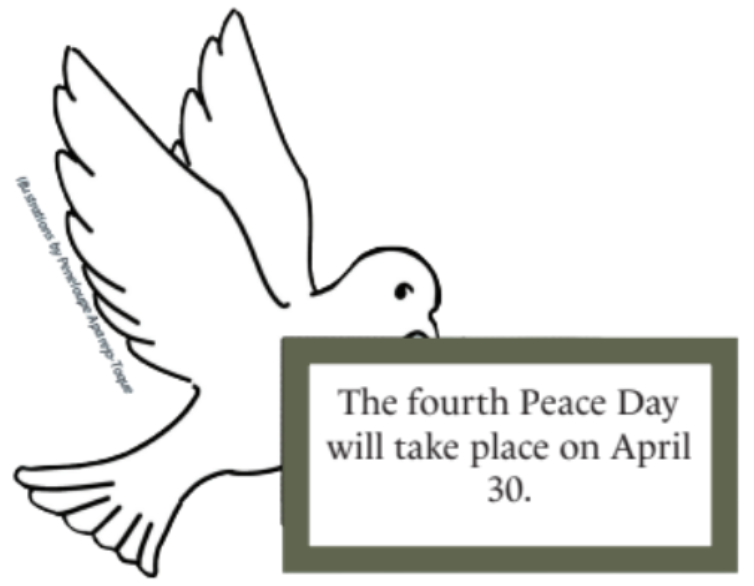
The first Peace Day was held on Sept. 21, and focused on the definition of peace, along with understanding the relationship between the individuals and the system they function within, Cohen said. The second Peace Day on Nov. 25 focused on the underworkings and conditions necessary for peace, guided by the UDHR. The third, on Feb. 12, concentrated on activism, with students actually splitting into their four specific tracks. The final Peace Day on April 30 will culminate the work students completed over the past Peace Days in their groups and export it to the community, Cohen explained.
While the goals of Peace Day may seem ambitious, the Academy also emphasizes the importance of small, everyday actions and values, Kim said. Making room for peace can be difficult, but whether it’s on a big scale, such as letters to a foreign country, or as small an act as holding a door open, peace matters, Kim said.
“It’s often hard to advocate for values that are important to us, when we seemingly do not have time because, in a sense, we have to take care of ourselves,” Kim said. “But the little things we do in our daily lives help more than we think, and finding time to stand up for these ideals is really important.”