

Heart pounding with anticipation, a student refreshes their PowerSchool app, eager to see their updated grades. No new numbers appear, the same grades that have been there for the past three weeks stare back at them. This is exactly what English Teacher Katrina Prockovic is trying to prevent through the use of ChatGPT to give her students faster, more in-depth feedback, Prockovic said.
It previously took Prockovic weeks to grade assignments from her three sections of AP Language and Composition (AP Lang) classes, which led her to pilot using Artificial Intelligence (AI) with a recent assignment in her AP Lang classes, allowing students to get almost immediate feedback, she said. The success has led Prockovic to consider using AI on a regular basis in the future, she added. AI helps Prockovic elaborate on feedback and provide students with examples of what next steps to take to earn a higher grade, she added. The fast-paced nature of the AP Lang classes means that students constantly produce work that requires lots of detailed grading, and the longer students wait for feedback, the less effective it becomes, as they have already moved on to other assignments, Prockovic added.
“Over the years, I’ve hated how long it takes me to give substantive feedback,” Prockovic said. “I give detailed feedback as often as I can, but it can take a week to get through three classes. It dilutes the helpfulness of the feedback if it’s not in close proximity to when they wrote that writing assignment.”
AP Lang students recently completed a literary analysis which Prockovic read herself while assigning a grade and completing a rubric, she said. With students’ permission, she then took models of feedback she had written previously and gave ChatGPT various specific instructions to guide it in giving expansive and nuanced feedback, Prockovic added. Prockovic has no intentions of hiding her new grading techniques, she said.
“I’m only comfortable using it if I’m candid with students about when and why,” Prockovic said. “We’re all grappling with the ethics of AI, and what better place to honestly and respectfully work through this technology that is impacting everyone’s lives than in the classroom. I look to the students in this case as much as they may look to me for what the fair, ethical, and practical limitations we should be placing on this are.”
Even though ChatGPT has made Prockovic a more effective grader, she does not use it to help her teach, Prockovic said. This creates an experience specific to the students she has gotten to know within her classrooms, she added.
“ChatGPT has not been able to effectively help me create better lesson plans, because the best lesson plans are ones specifically tailored to the kids in front of you on any given day,” Prockovic said.
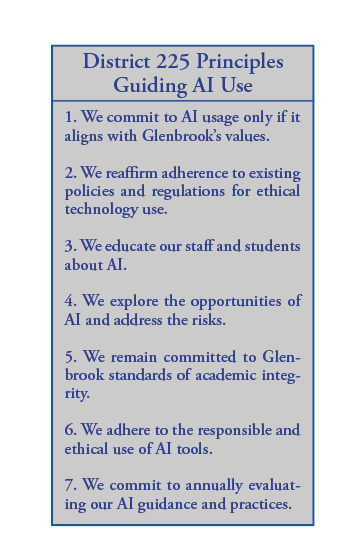
The current district policy on teachers’ use of AI is a value-based one, Dr. Joyce Kim, Associate Principal of Teaching and Learning, said. Departments and course teams decide how to apply each principle regarding AI use. If a course team determines AI use aligns with their course values, they will communicate the appropriate uses for their class or assignments, Kim said.
“Promoting AI literacy among staff is central to addressing a values-based approach,” Kim said. “Staff will be given support to develop their AI literacy, which includes when and when not to use it and how to use it thoughtfully.”

There are not specific expectations of when to disclose AI use by teachers if the resources are only meant to be used in classrooms, and not published, Kim said. This vagueness allows teachers to use AI to meet the needs of all students, without making them feel outed Kim added.
“Teachers have full discretion if they want to share that they used AI to create an activity because the resources are solely for educational purposes for the benefit of students,” Kim said.
Many students feel more comfortable using AI when instructed by the teacher, sophomore Anastasija Tomicevic said. Having specific guidelines on when and what it should be used for makes AI seem less taboo, she added.
“I don’t feel too bad when my Career and Technical Education (CTE) teachers ask us to use AI in the classroom, because I know I’m using it responsibly,” Tomicevic said.
While some students feel that guided AI use is acceptable, it is not always appropriate to use, CTE Teacher Mike Jones said. By slowly incorporating AI in his lesson plans by creating interview questions or hypothetical business situations, he familiarizes students with different terminology, he added. However, its inconsistency is a fault, due to its tendency to provide vague or incorrect information and pass it off as the truth, Jones said.
“AI overview is far from reliable but if you can break down the actual sources it is pulling from, we can begin to learn and understand,” Jones said.
On the other hand, CTE Teacher Mike Sinde believes AI has expanded what students are able to do. AI has helped with troubleshooting and debugging coding, as well as research and formatting in class, Sinde said.
However, not only does AI have many limitations, it also poses ethical issues through students tendency to become overreliant on it, Sinde said.
“I don’t want the AI’s work,” Sinde said. “I want you to do your work, and the AI is there to assist you. Make sure it’s something that adds to your original thought, your original work, not something that takes away from your original thought.”
Though AI use may be rapidly growing at South, it cannot currently replace the learned experience and mastery of a teacher, Kim said. Therefore, a sense of caution cloaks teachers when it comes to AI use, she said.
“No AI tool can replace the relationship between the teacher and the student,” Kim said. “It would be unethical to solely use AI to evaluate students’ learning. While there are teachers across the spectrum of comfort with using AI, at this time, most of our teachers are cautious about AI because they want to ensure that evaluating learning is free from external influences.”